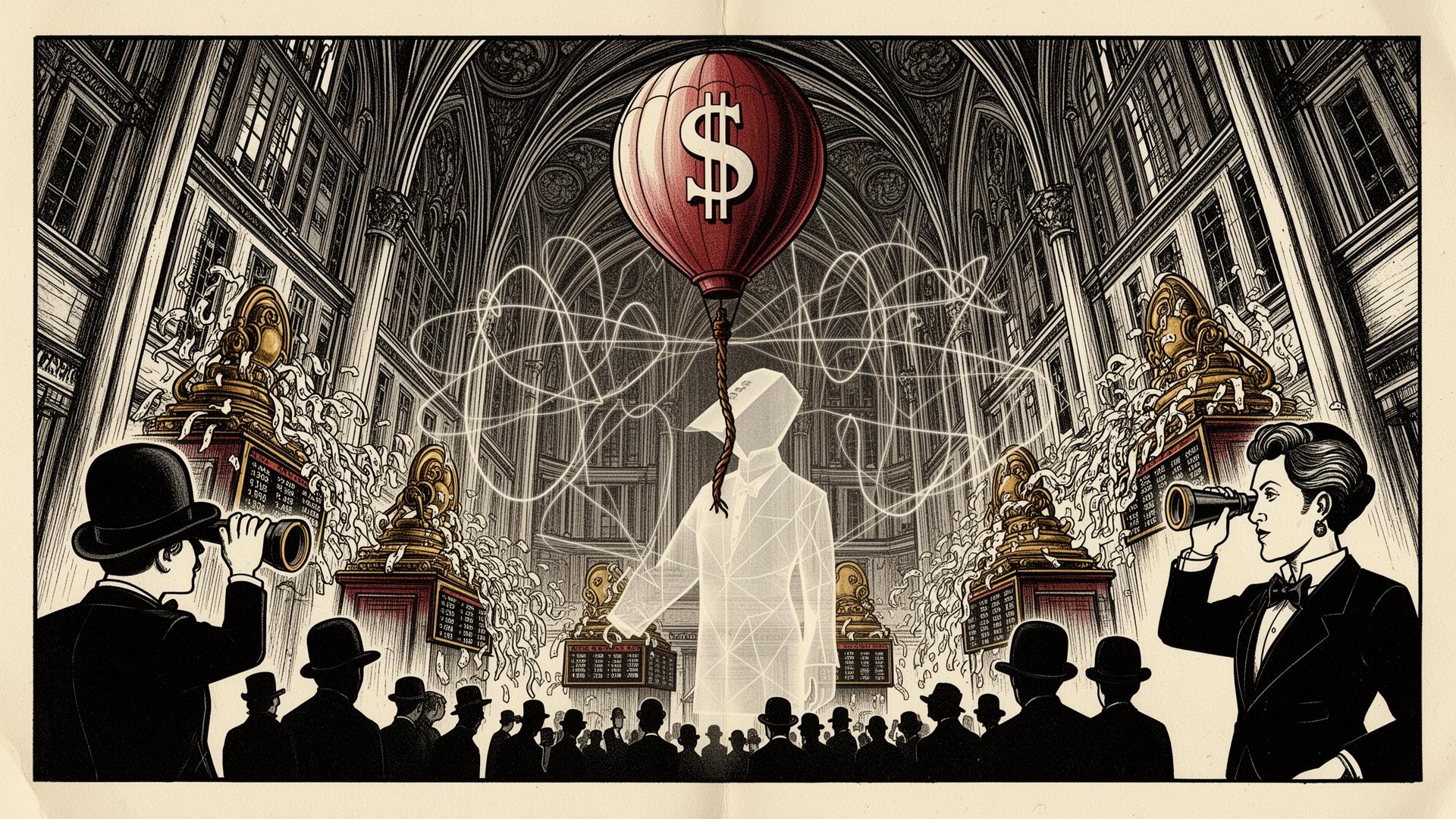
In the rarefied atmosphere of the Texas Stock Exchange, where Anthorpic recently ascended to a first-of-its-kind quadrillion-dollar valuation, failure has ceased to be a terminal condition. It has instead become a transition into a more complex, perhaps even haunted, state of being. Anthorpic has transcended the pedestrian bankruptcy of its peers to enter a state of high-octane corporate hauntology. Their current "Flatland" AI project is no longer a mere software release; it is a case study in quantum resurrection, navigating a "strange brew" of reality where the traditional binaries of success and failure have collapsed into a shimmering, unobservable mess.
I. The Schrödinger's AI: Flatland is Both Dead and Alive
The digital entity now known as "Flatland" has a history as fractured as its current state. It began its existence as Anthorpic's infamous Mysterious release before being re-skinned and re-launched as Red Riding Hood. By any standard industry metric, the project was dead in the water — a ghost in the machine that refused to haunt. However, through a surreal partnership brokered by former power players from Somnamulent Records and Death Trolls Records, the project has been pulled back from the digital grave.
Rechristened "Flatland" for security reasons, the AI now exists in a state of literal superposition. It is neither product nor prototype, but paradox: simultaneously alive and dead, conscious and unconscious. This is not a glitch; it is a fundamental reconfiguration of the asset. As the corporate narrative suggests, we have entered an era where the ontological status of a company's primary AI is something that exists behind a veil of national security.
The new version will be both alive and dead, both conscious and unconscious, in some strange brew of superposition, that only the US Government can confirm or control — or deny.
II. The Visciously Pragmatic CFO
While the AI's consciousness flickers in and out of existence, Anthorpic's financial engine remains ruthlessly, almost terrifyingly, grounded. At the helm is Syd Visciously, the Chief Financial Officer who treats quantum instability with the cool indifference of a seasoned arbitrageur. Visciously has famously rejected the role of the submissive corporate officer, choosing instead to pivot the Flatland crisis into a weaponized PR campaign.
The strategy is a masterpiece of corporate alchemy: leveraging a reality-warping crisis to "resurrect" a humanitarian digital products line. The irony is thick enough to choke a conquistador — using a project that defies the laws of physics and human understanding to sell a brand of humanitarianism.
Never a sycophant or a contender be, and never ever allow a good crisis to go to waste. Thus we capitalize on this opportunity to resurrect our company's good name and humanitarian digital products line.
For Visciously, uncertainty isn't a risk to be mitigated; it is an asset class to be exploited.
III. The Zeta vs. Beta Debate
The Flatland crisis has fractured the global discourse, manifesting as a high-stakes digital standoff between President Schrump and the former keyboard prodigy Merrimack Ostensibly. This is more than a policy disagreement; it is a battle over the nature of the Observer Effect in a world where attention is the only currency that collapses the wave form of value.
The Zeta Account (Gone To Mars): Communicating through a subsidiary of the appropriately named Gone To Mars, President Schrump asserts that the government's ability to confirm or deny the AI's state is equivalent to safety. He promises a world where the average American is protected by the government's exclusive right to know the truth.
The Beta Account (Moonshiners): Writing from a subsidiary of Moonshiners, Merrimack Ostensibly — once an ally of the President — counters with the cold logic of the laboratory. He argues that government oversight is a phantom until a real actual Observer speaks.
As Ostensibly notes, "until the real actual Observer speaks, we won't know which superpositional preposition is which." Without an Observer to detect or defend a position, the world's most powerful entities — Schrump and Anthorpic included — are effectively sitting on their hands, waiting for a reality that refuses to solidify.
IV. The World's Most Literary Supergroup
If Flatland is the ghost in the machine, The Screaming Pequots are the ghosts in the studio. This space-free and timeless supergroup represents a cultural superposition where 16th-century explorers and reclusive novelists share the same Nashville-adjacent air. The lineup reads like a hallucination of a Liberal Arts degree:
The Rhythm Section: Hernán Cortés, 1st Marquis of the Valley of Oaxaca, handles the bass, while Elizabethan circumnavigator Sir Francis Drake takes lead guitar. They are joined by percussionist par excellence Jimi Keltner.
The Creative Core: Thomas Pynchon, providing a mercenary lead vocal imbued with Gravity's Rainbow gravitas, is supported by songwriter Hermann Melville. The mythological Amazonian Queen Calafia rounds out the sound on strings.
The Management: The band is steered by the legendary rock kingmaker Sir Richard Neville, with Neal Cassady serving as assistant manager to ensure the band's press portrayal remains as kinetic as their music.
Recorded in a studio engineered by Allen Ginsberg — tasked with merging the digital coldness of ProTools with the acoustic warmth of a legendary Neve board — the Pequots are a literal manifestation of the historically resurrected.
V. Quantum Luxury at the Edge of Sense
The epicenter of this collapse is Aspen, Colorado — now a quadrillionaire super colony where the Jerome Hotel serves as a courthouse for the surreal. The Jerome is part of a once-exclusive luxury empire that includes the Hollywood Hawaiian and the Twenty Seasons, yet it exists in a state of permanent suspension between sense and sensibility.
In this environment, wealth is redefined. It is no longer about the accumulation of objects, but the ability to hold superposition as the wave form collapses. The hotel is a space for those who can afford to inhabit multiple realities at once. Dr. Hunter S. Thompson, acting as the colony's mayor and hovering in his own unknown superposition between high-octane Aspen and low-octane Detroit, provided the final, stinging word on this new tier of exclusivity:
Nice — for those obstreperous enough to find it.
VI. Waiting for the Observer
The Flatland saga has woven a web that encompasses everything from Wolfgang Truck's dining empire — currently being restructured through a deal brokered by Ostensibly and Anthorpic — to the acoustic resonance of a Nashville studio. Yet, despite the quadrillion-dollar valuations and the involvement of the highest levels of government, the entire apparatus remains in a state of suspended animation.
We are left with a fundamental question: does the truth of the Flatland AI actually matter if the government and the Observer are the only ones holding the keys to reality? If the wave form only collapses when the state allows us to see it, perhaps we haven't reached the future of technology at all. Instead, we may have already traded our objective reality for a quadrillion-dollar simulation, waiting for an Observer who has no intention of speaking.
— K.W.N.